Welcome to this week’s edition of Frankly Speaking – where we update our growers on the latest industry and fruit performance.
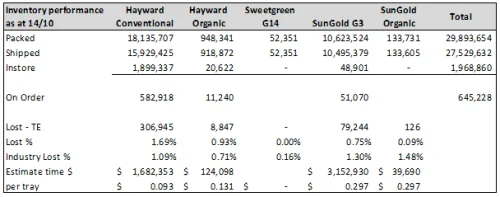
This week the last of the Gold3 is being shipped, and we now have more orders than inventory. Gold3’s remarkable fruit quality continues, with fruit loss at Seeka of 0.74% [less than 1 percent] at week 41, this is remarkable. Hayward organic Seeka fruit loss is 0.82% slightly higher than the industry average of 0.71%, with another 5 weeks of shipping scheduled. The Hayward conventional Seeka fruit loss 1.7% is more than the industry average of 1.09% but is still low and net time income is in line with the August forecast. There are six more weeks of shipping scheduled for Hayward conventional.
Seeka Growers Council met last week. As well as approving the October payment there was a discussion on Zespri’s proposal that size 39 Gold fruit become non-standard supply for the 2019 harvest. Zespri advised demand for the Gold3 size 39 is limited with the expectation that the market can successfully sell between 50 and 60% of next years forecasted supply. The council supported this recommendation, if you have any feedback on this recommendation please contact your Client Relationship Manager [CRM].
Zespri updated the Council on market conditions and how kiwifruit sales are tracking. With 51.4m trays of Hayward conventional sold, there remains 24.5m trays to sell, 11.4m more than the same time last year. Markets will be selling a couple of weeks later than last year. Already having sold more than last year in total, there remains 0.9m trays to sell to complete the Hayward organic programme. The Gold3 programme has nearly sold 60m trays and there is 6.3m trays remaining to sell.
The increasing Gold3 supply means going forward the Gold3 and the Hayward conventional crop will have a longer selling window. The council has questioned Zespri on the amount and timing of payments this year; in particular the low value of the Hayward conventional progress payments for September / October and November. The higher crop volumes and longer selling window means Zespri is borrowing more for longer compared to the last two years, impacting on the amount of the progress payments paid to date. If this is the “new norm”, it is time to question the timing of the incentive payments [kiwistart and taste] so the “time grower” receives more of an even share of the payments through these months when on orchard costs are high.
Kind regards,
Michael
Seeka Key
Contacts